 admin
admin


How To Measure For A Slipcover For Chair
A regular dining chair requires about 2 to 3 yards of cloth; a standard-sized single sofa or club chair is usually between 6 and 8 yards; and a larger dormer chair usually requires 10 to 12 yards.
Please note that this is only the base amount to cover the chair and cushion, reserving standard seam allowance. There are a few things you have to consider “hidden variables”: if you want a hem or piping, add an extra 1.5 to 2 yards; if your fabric has a large loop pattern of more than 7 inches, or if it’s a fabric like velvet or corduroy with a well-defined direction of downing, To ensure perfect alignment of the backrest and cushion lines, you must order 15% to 20% more than the total amount. Finally, always remember to set aside 10% “life-saving margin” to deal with cutting errors. After all, there are cylinder differences between different batches of fabric, and it is difficult to ensure that the colors are exactly the same when restocking later.

Step 1. Estimate Standard Supplies Based On Chair Type
The first step in measuring your sofa cover is to give your furniture first “qualitatively”. Based on the industry standard 54-inch fabric width, here’s my list of professional materials:
Dining Chair (2 to 3 yards): This is the easiest to estimate. This amount usually covers a standard Parson chair or one with a padded back.
Single Sofa/Club Chair (Sizes 6 to 8): This chair has more armrests and the cushions are usually deeper. The extra fabric is to ensure the sofa cover drapes naturally and has enough depth to fit into the gaps in the furniture.
Dormer Chair (10 to 12 yards): This chair is the most cloth-eating. The high backrest, the “wings” on the sides, and the intricate curves make it a fabric killer. Height and depth must be measured with extreme precision, otherwise there is no way to remedy it once it is cut short.
Step 2. Don’t Miss Decorative Details
Many people only look at the surface area of furniture when measuring, which is a very amateurish mistake. To create that haute couture feel, you have to factor in these decorative elements:
Skirts: Whether you want a traditional pleated skirt or a simple straight skirt, add 1.5 to 2 yards to the total. The skirt not only increases the vertical material usage, but the folding and pleating at the corners are also a big material consumer.
Piping and Welting: Adding a circle of contrasting or matching piping to the seams can indeed instantly elevate the quality, but this requires cutting large pieces of fabric into countless long strips to wrap around the core rope. In my experience, this process also typically requires an additional 1.5 to 2 yards of fabric.
Step 3. Adjust For Pattern Cycles And Fabric Orientation
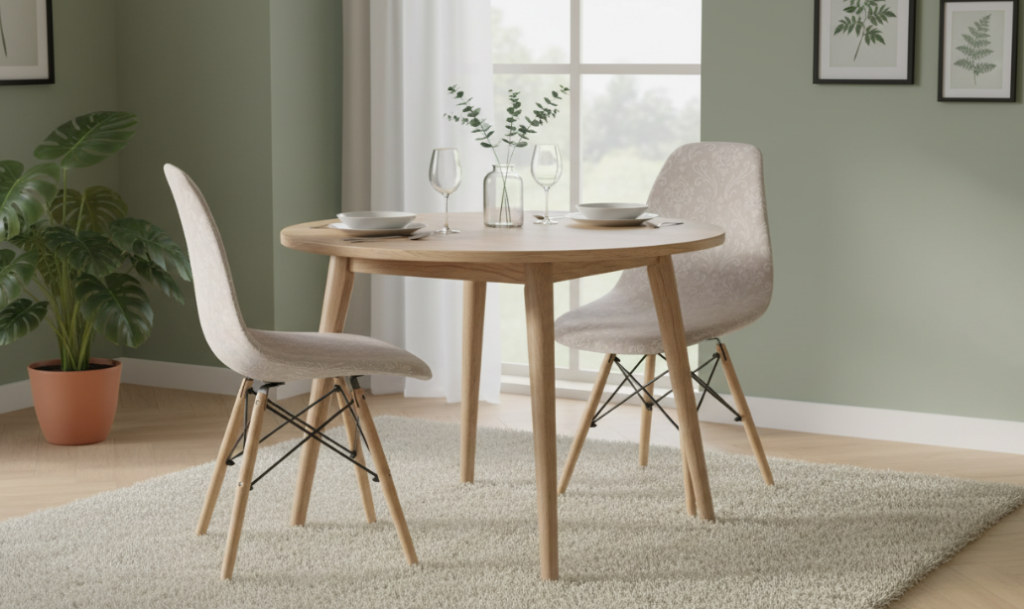
The fabric texture you choose completely overturns the previous measurement logic. The logic of solid cotton is completely inapplicable to complex tweed or velvet.
Large Loop Pattern: If you choose a pattern loop longer than 7 inches, you absolutely cannot “cut which one fits”. In order for the flowers or geometric patterns to extend smoothly from the backrest to the cushion, you have to reserve 15% to 20% of the loss for “the opposite flower”.
Directed texture and “down-hairing”: Fabrics such as velvet or corduroy are directional. If the cut is in the opposite direction, your chair will look like it’s made of two colors of fabric when the light shines on it. For this type of fabric, it is also necessary to increase the allowance by 15% to 20% to ensure that all cuts are in the same direction.
Step 4. Ultimate Calculation: 10% Safety Margin
After arriving at the final figure, I strongly recommend adding a 10% safety margin. Professional veteran tailors will insist on this for two reasons:
One is to avoid human error. Even if you measure carefully, your knife may shake, or there may be a flaw in the middle of a piece of fabric that is just drawing. Having an extra yard of cloth in your hand can prevent the entire project from being scrapped due to a mistake.
The second is to cope with the dye lot. The cloth is dyed in batches. If you find out halfway through that you’re out of cloth and need to restock, the new roll of cloth you received will likely have a slight color difference from the previous one. Buying 10% more in one step not only ensures the uniform color of the whole set, but also allows you to save it for making an armrest cover or making local repairs later.
Author: Julian Mercer
Hi, with years of experience in professional upholstery and custom furniture design, I’ve learned that the secret to a perfect “haute couture” finish lies in the details that most people overlook. From calculating the complex curves of a Wingback chair to accounting for the subtle “nap” of luxury velvet, I specialize in navigating the hidden variables of fabric estimation. My goal is to share my professional judgment to help you avoid common cutting errors and ensure your projects always result in a seamless, high-quality transformation.